By Francisco Mastromarino, Founder, Quick.bot · May 30, 2026
Botpress vs ManyChat for WhatsApp: Which One is the Best Tool for You?
Choosing between Botpress and ManyChat depends on what you actually want to achieve with your WhatsApp automation.
ManyChat is designed for fast setup and marketing-focused workflows, while Botpress is built for advanced AI-driven conversations and complex integrations.
In this guide, you’ll learn how Botpress vs ManyChat compare for WhatsApp, including real use cases, workflow differences, and key trade-offs.
This is ideal for marketers, founders, and teams who want to pick the right tool based on their needs, not just features, and build chatbot systems that actually perform.
What is Botpress and who should use it?
Botpress is an AI-powered chatbot platform designed for building advanced, customizable conversational workflows with deep logic and integrations.
Unlike simple drag-and-drop tools, Botpress gives you more control over how conversations behave, making it well-suited for handling complex use cases such as dynamic responses, API-based actions, and multi-step automation.
It is best suited for:
- startups and SaaS teams that need scalable automation
- businesses handling complex customer queries
- teams that want AI-driven conversations instead of fixed flows
- developers or technical users who need flexibility and integrations
Mini example:
- User: “I want to check my order status.”
- Bot: “Please enter your order ID.”
- Bot fetches data from the backend system via API
- Bot responds: “Your order #1234 is out for delivery and will arrive today by 6 PM.”
In this case, the chatbot is not just following a fixed script; it is pulling real-time data and responding dynamically based on user input.
What is ManyChat and who should use it?
ManyChat is a no-code chatbot platform designed for building simple, marketing-focused conversation flows with a visual drag-and-drop builder.
It allows businesses to quickly create automated messages, lead capture funnels, and basic WhatsApp workflows without any technical setup.
It is best suited for:
- marketers and agencies running lead generation campaigns
- small businesses that need quick and simple automation
- teams focused on WhatsApp marketing and broadcasts
- users who prefer ease of use over advanced customization
Mini example:
- User: “pricing”
- Bot: “Are you looking for personal or business use?”
- User selects “business.”
- Bot: “How many team members do you have?”
- Bot collects the response and asks for the email
- Bot sends pricing details and tags the lead
In this case, the chatbot follows a structured flow to capture and qualify leads, making it ideal for marketing and funnel-based use cases.
Botpress vs ManyChat: quick comparison
If you are in a hurry and need a quick comparison result, we have got you covered:
Botpress is built for flexibility and advanced use cases, while ManyChat is optimized for simplicity and speed, making the right choice depend on your automation needs.
Botpress vs ManyChat: key differences explained
Let’s move to the detailed comparison of these platforms. We will be taking a look at
- Ease of use
- WhatsApp automation capabilities
- AI capabilities
- Integrations and flexibility
- Pricing structure
- Customer support
And so on. Without any further ado, let’s get into the comparison.
Ease of use
Botpress is more powerful but harder to learn, while ManyChat is easier to use and faster for beginners to get started with.
Learning curve. Botpress has a steeper learning curve because it involves understanding workflows, logic, integrations, and sometimes custom code. Even though it provides a visual builder, you still need to think in terms of system design rather than simple message flows.
ManyChat is designed for non-technical users. Its drag-and-drop interface and pre-built templates allow you to create chatbot flows without prior experience. Most users can understand the basics within a few hours.
What this means in practice:
- Botpress requires time to learn, but offers more control
- ManyChat is beginner-friendly and quick to pick up
Interface and workflow builder. Botpress provides a visual flow builder, but it is designed to handle complex logic and multi-step automation. This means the interface can feel heavier, especially when working with conditions, APIs, and AI behavior.
ManyChat offers a simpler visual builder focused on linear flows. You connect steps like messages, buttons, and actions in a straightforward way, which makes it easier to understand and manage.
Difference:
- Botpress interface is built for complexity
- ManyChat interface is built for simplicity
Setup experience. Botpress setup involves defining logic, handling edge cases, and, sometimes, connecting to external systems. This makes the initial setup slower and more involved.
ManyChat lets you launch quickly with templates and pre-built flows. You can create a working chatbot without worrying about deeper logic or integrations.
Example:
- ManyChat: Create a lead capture flow in a few steps and publish
- Botpress: Define flow, add logic, connect API, test multiple scenarios
Customization vs simplicity trade-off. Botpress gives you flexibility, but that flexibility comes at the cost of simplicity. You can customize almost every part of the chatbot, including logic, data handling, and integrations.
ManyChat keeps things simple by limiting customization. You work within its system, which makes it easier to use but restricts what you can build.
What this means for you:
- Choose Botpress if you are comfortable learning a more advanced system and need full control over workflows
- Choose ManyChat if you want a simple, intuitive tool that lets you build and launch quickly without technical effort
In short, ManyChat is easier to use and faster to get started with, while Botpress requires more upfront effort but offers greater flexibility to build more advanced chatbot systems.
WhatsApp automation capabilities
Botpress is better for advanced, integration-driven WhatsApp automation, while ManyChat is better for structured marketing automation, such as campaigns and lead capture.
Botpress supports complex workflows that go beyond messaging. It can trigger backend processes, connect to APIs, and handle multi-step automation based on user input and real-time data.
This makes it suitable for use cases such as customer support, onboarding, and system-driven workflows that require logic and integrations.
ManyChat focuses on structured automation using predefined flows. It works best for sending messages, capturing leads, running campaigns, and guiding users through simple paths using keywords and buttons.
This makes it effective for marketing and high-volume interactions where conversations are predictable. Botpress allows flexible triggers based on user intent, external events, and data, while ManyChat relies on keyword triggers, button clicks, and basic conditions.
Botpress also handles personalization at a deeper level by leveraging context and real-time data, whereas ManyChat uses tags and user input for basic segmentation.
In short, choose Botpress if you need advanced, scalable automation connected to your systems, and choose ManyChat if you want simple, fast-to-launch WhatsApp workflows focused on marketing and lead generation.
AI capabilities
Botpress offers more advanced AI capabilities, while ManyChat provides basic AI features within structured, rule-based workflows. Botpress is built for AI-driven conversations.
It can understand user intent, handle open-ended queries, and generate dynamic responses instead of following fixed paths. You can connect it to custom data sources like documents, APIs, or databases, allowing the bot to give context-aware answers.
It also supports memory, so conversations can carry context across multiple interactions. ManyChat includes AI features, but they work within predefined flows. It can handle simple variations in user input and generate responses, but most interactions still rely on rules, keywords, and structured paths.
It is not designed for deep AI training or handling complex, unpredictable conversations. In practical terms, Botpress can manage more natural, flexible conversations, while ManyChat works best when interactions are guided and predictable.
In short, choose Botpress if you need advanced AI with context and dynamic responses, and choose ManyChat if you want simple AI support within structured chatbot flows.
Integrations and flexibility
Botpress offers deeper integrations and higher flexibility, while ManyChat provides simpler integrations with more limited customization. Botpress is built for integration-heavy workflows.
It can connect to APIs, CRMs, databases, and internal systems, allowing you to fetch, update, and process data in real time.
You can define custom logic, create dynamic workflows, and control how data flows between systems, which makes it suitable for complex automation and backend-driven use cases.
ManyChat supports integrations, but they are more focused on common tools and basic data syncing.
It works well for connecting to marketing platforms, collecting user data, and triggering simple actions, but it has limitations when handling complex workflows or real-time data processing.
In terms of flexibility, Botpress gives you full control over how your chatbot behaves, including logic, data handling, and integrations. ManyChat keeps things simple by limiting customization, which makes it easier to use but restricts advanced use cases.
In short, choose Botpress if you need deep integrations and full control over automation, and choose ManyChat if you want simple integrations that support basic workflows without added complexity.
Pricing structure
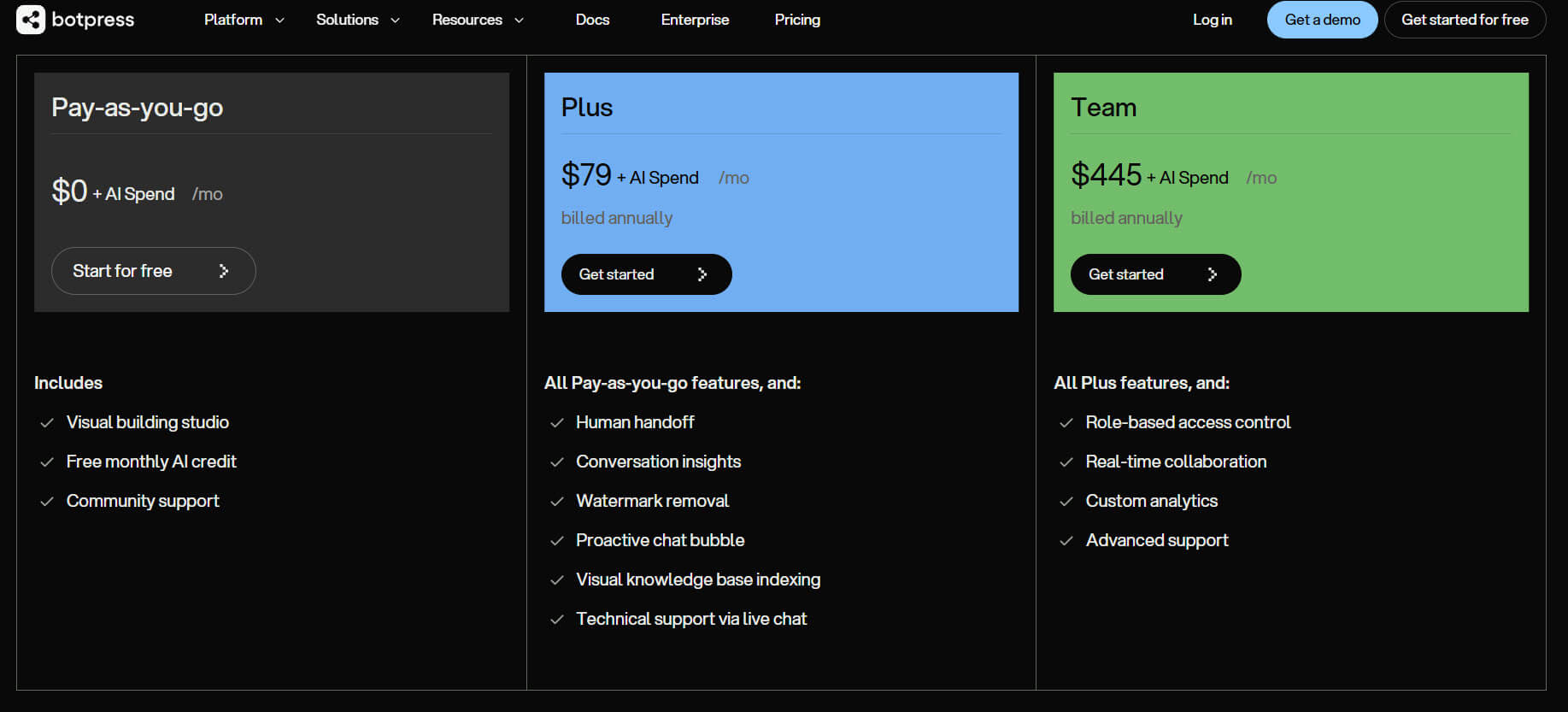
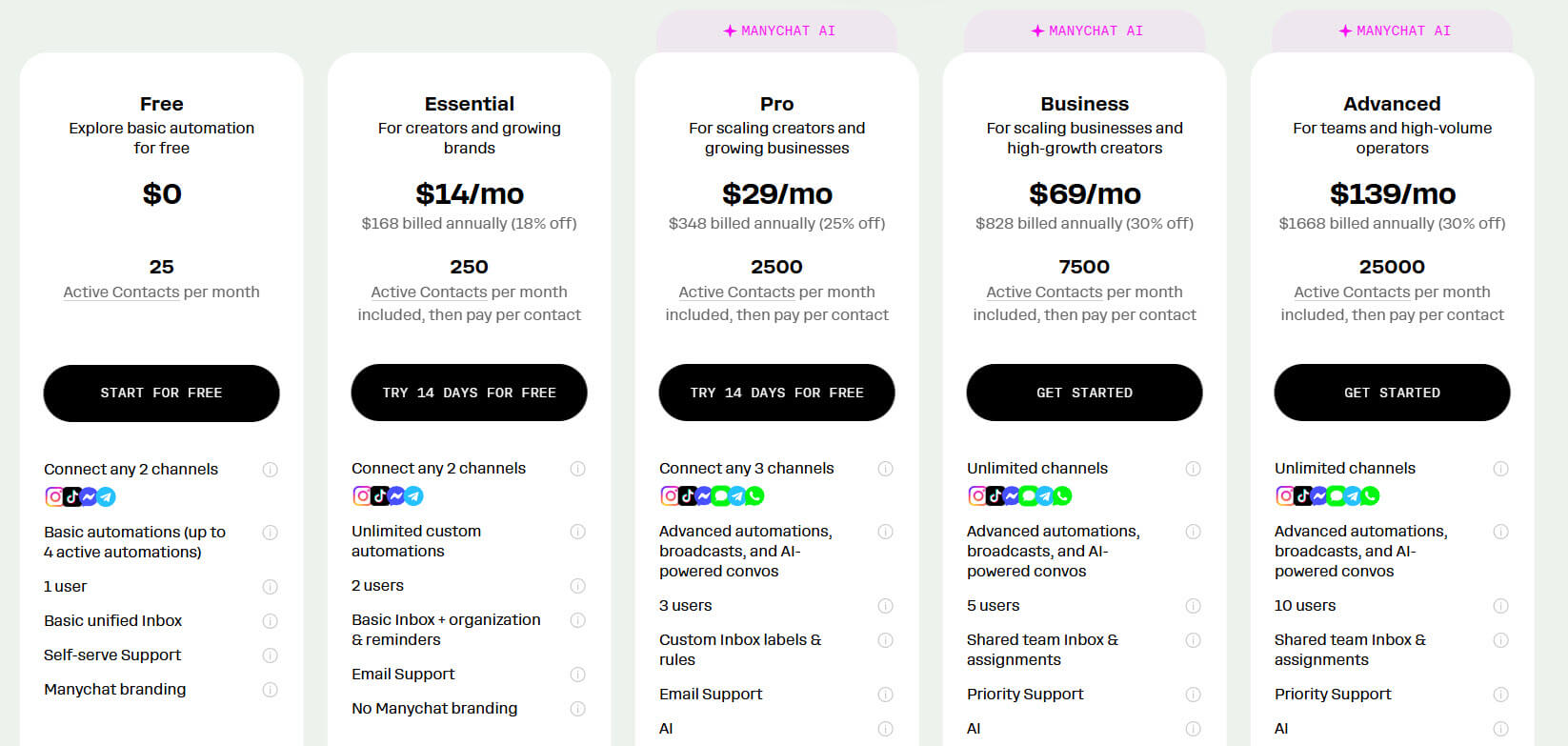
Botpress uses a usage-based pricing model with AI costs, while ManyChat uses a contact-based pricing model that scales with your audience size. This difference directly impacts how predictable your costs are and how they scale as you grow.
Botpress pricing. BotPress has three pricing models:
- Free - $0
- Plus - $79 + AI spend a month
- Team - $445 + AI spend a month
ManyChat pricing. ManyChat comes with five pricing models:
- Free - $0
- Essential - $14 a month
- Pro - $29 a month
- Business - $69 a month
- Advanced - $139 a month
What this means for you:
- Choose ManyChat if you want simple, predictable pricing tied to your audience size
- Choose Botpress if you need flexibility and are okay with variable costs based on usage and AI
In short, ManyChat is easier to budget for, while Botpress gives you more control but requires closer monitoring of usage as your chatbot scales.
Customer support
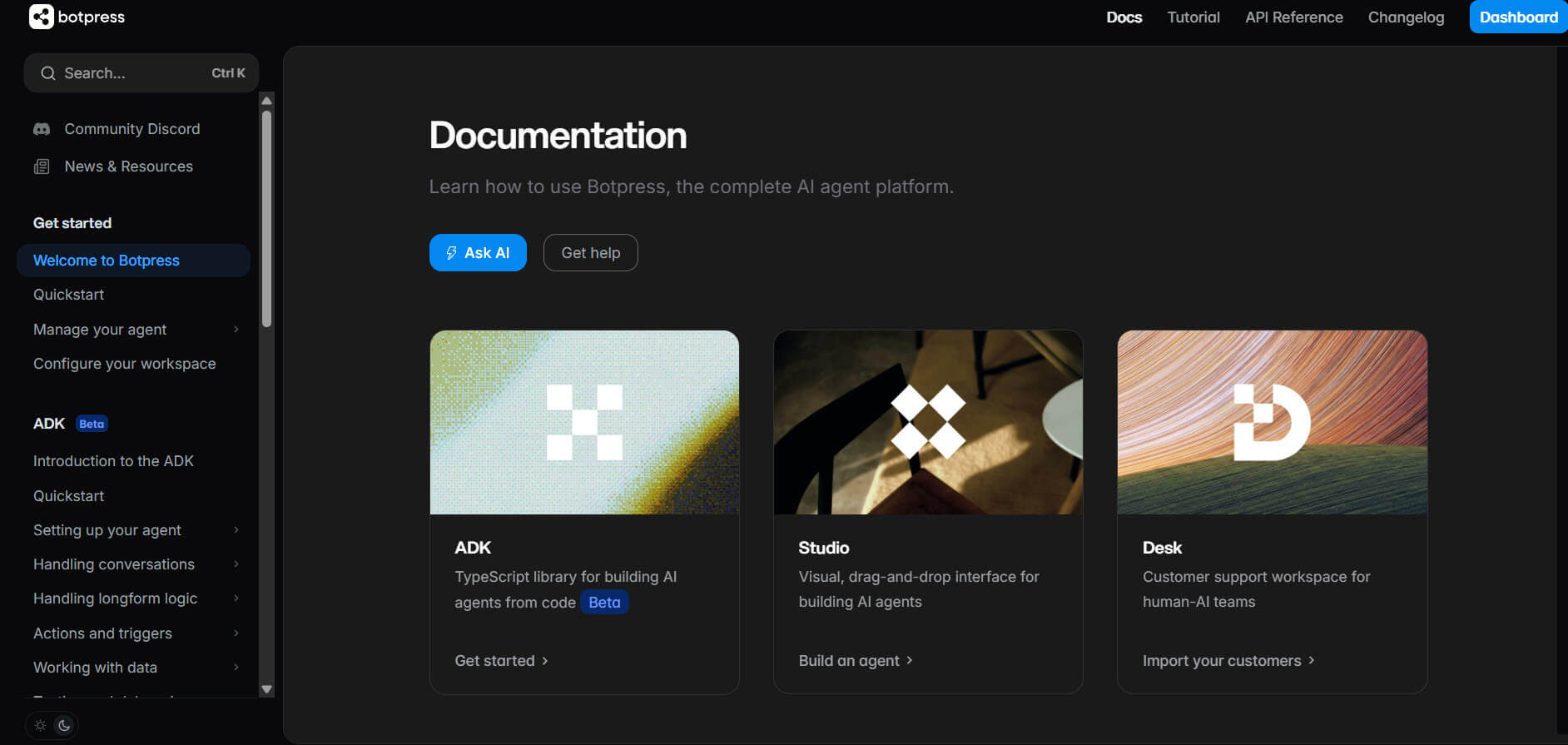
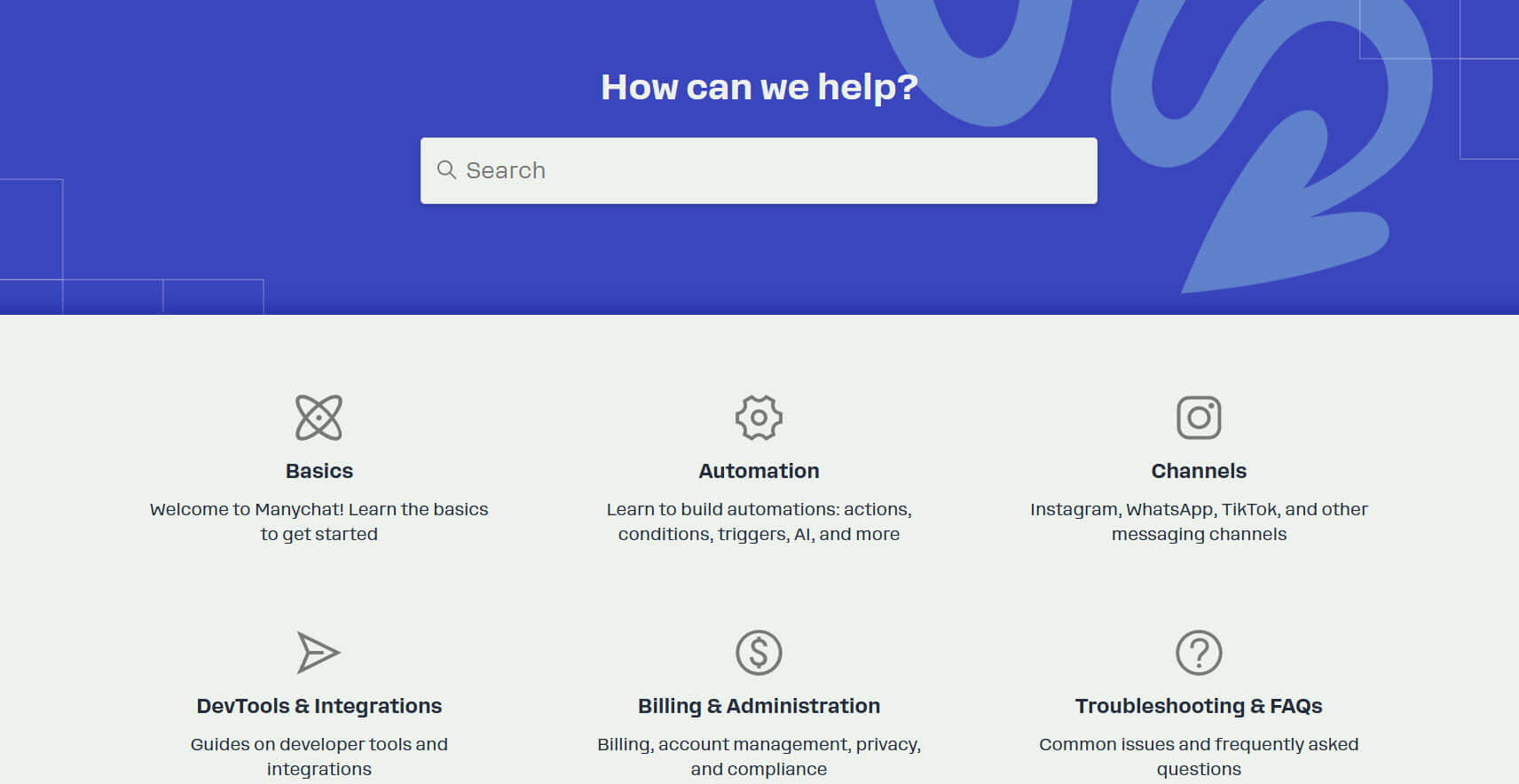
ManyChat offers more beginner-friendly support and documentation, while Botpress provides deeper technical resources but requires more effort to navigate and implement.
Documentation quality and learning resources. ManyChat focuses on simplicity. Its documentation is structured for non-technical users, with step-by-step guides, tutorials, and visual examples that help you get started quickly.
Most features are explained straightforwardly, making it easy to build basic workflows without confusion.
Botpress documentation is more technical and detailed.
It covers advanced topics like APIs, AI behavior, and custom workflows, but assumes a certain level of understanding. While it is powerful, beginners may find it harder to follow compared to ManyChat.
Ease of finding answers. With ManyChat, most common questions can be solved quickly through guides or built-in help. Since the platform is simpler, issues are usually easier to diagnose and fix.
With Botpress, finding answers may take longer because problems often involve logic, integrations, or custom setups. The documentation is comprehensive, but not always beginner-friendly.
Support channels and response experience. ManyChat is designed for a broader user base, so support is more accessible for common setup, flow, and campaign issues. This makes it easier for small teams to get unstuck quickly.
Botpress support is more aligned with technical use cases. It is helpful for debugging advanced workflows or integrations, but may require more context and technical understanding from the user.
In short, ManyChat makes it easier to get started and quickly solve common issues, while Botpress provides the depth needed for complex implementations but requires more effort to fully utilize.
Real use case comparison
The difference between Botpress and ManyChat becomes clear when you look at how they perform in real business scenarios, especially in terms of flexibility, speed, and depth of automation.
Lead generation
Botpress approach: More dynamic and personalized lead qualification.
- User: “I’m exploring options for my team.”
- Bot: “How many users are you planning for?”
- The bot adapts questions based on response
- Scores lead based on inputs
- Sends data to CRM
Outcome:
- Lead is enriched with more context
- Automatically prioritized based on intent
- Integrated directly into backend systems
ManyChat approach: Designed for structured lead capture using simple flows.
- User: “pricing”
- Bot: “Are you looking for personal or business use?”
- “How many team members do you have?”
- “Can you share your email?”
Outcome:
- Lead is captured quickly
- User is tagged and added to a campaign
- Follow-up messages can be automated
Customer support
Botpress approach: Handles support with dynamic responses and integrations.
- User: “Where is my order?”
- Bot retrieves real-time data from backend
- Bot: “Your order #1234 is out for delivery today”
Outcome:
- Real-time, accurate responses
- Can handle follow-up questions contextually
ManyChat approach: Handles common queries using predefined responses.
- User: “Where is my order?”
- Bot: “Please enter your order ID”
- Static or limited lookup capability
Outcome:
- Works well for basic FAQs
- Limited handling of complex or unexpected queries
WhatsApp marketing campaigns
Botpress approach: More personalized and logic-driven messaging.
- Sends messages based on user behavior and data
- Adapts messaging dynamically
Outcome:
- More tailored user experience
- Requires more setup and planning
ManyChat approach: Built specifically for campaigns and broadcasts.
- Send bulk messages
- Run promotions
- Trigger follow-ups based on user actions
Outcome:
- Easy to launch campaigns
- Strong for engagement and conversions
This comparison shows a clear pattern: ManyChat is optimized for speed and structured workflows, while Botpress is designed for deeper automation, personalization, and integration-driven use cases.
What are some example workflows for both options
The main difference between Botpress and ManyChat becomes clear when you look at how workflows are actually built and executed.
Botpress workflow example (dynamic support + data retrieval)
Botpress workflows are more flexible and can handle dynamic, real-time interactions.
- Trigger: User sends “Where is my order?”
- Bot: “Please enter your order ID.”
- User inputs ID
- Bot connects to the backend system via API
- Retrieves order data
- Bot: “Your order #1234 is out for delivery and will arrive today by 6 PM.”
- Optional follow-up:
- Bot: “Would you like updates via WhatsApp notifications?”
Outcome:
- Real-time data is fetched
- Response is personalized
- The user can continue interacting dynamically
This type of workflow is ideal for businesses that need real-time responses, integrations, and more advanced automation beyond fixed flows.
ManyChat workflow example (lead capture)
ManyChat focuses on simple, structured flows designed for marketing and lead generation.
- Trigger: User sends “pricing.”
- Bot: “Are you looking for personal or business use?”
- User selects an option
- If business:
- Bot: “How many team members do you have?”
- If personal:
- Bot: “What are you trying to achieve?”
- Bot: “Can you share your email so we can send details?”
- User submits email
Outcome:
- Lead is captured
- User is tagged based on responses
- Follow-up message or campaign is triggered
This type of workflow is easy to build and works well for quickly capturing and qualifying leads.
Pros and cons of each platform
Both Botpress and ManyChat are powerful, but they are built for very different levels of complexity and use cases, so their strengths and limitations become clear depending on what you need.
Botpress pros
- Highly flexible, supports complex workflows, logic, and custom automation
- Strong AI capabilities with support for dynamic responses and context handling
- Allows API integrations, database connections, and real-time data retrieval
- Supports custom code, enabling full control over chatbot behavior
- Suitable for advanced use cases like support automation, SaaS workflows, and enterprise systems
Botpress cons
- Steeper learning curve compared to no-code tools like ManyChat
- Takes longer to set up and requires proper planning
- May be overkill for simple use cases like basic lead capture or FAQs
- Higher complexity can increase development and maintenance effort
- Requires more technical understanding to fully utilize its capabilities
ManyChat pros
- Very easy to use with a visual drag-and-drop builder, ideal for non-technical users
- Fast setup, you can launch basic WhatsApp flows within hours
- Strong for marketing use cases like lead generation, broadcasts, and campaigns
- Pre-built templates and tools reduce the need for planning from scratch
- Works well for predictable, structured conversations like FAQs and funnels
ManyChat cons
- Limited flexibility for complex workflows or multi-step logic
- Relies heavily on predefined flows, making it less effective for dynamic conversations
- No support for custom code inside flows, which restricts advanced customization
- Not ideal for handling complex support queries or backend-driven automation
- Can become restrictive as business needs scale
This makes the trade-off clear: ManyChat is optimized for speed and simplicity, while Botpress is built for flexibility and advanced automation, so the right choice depends on how complex your WhatsApp workflows need to be.
Limitations you should know before making the final decision
Both Botpress and ManyChat have limitations, and choosing the wrong one for your use case can lead to unnecessary complexity or restricted functionality.
Botpress limitations
- Requires more setup time and planning before going live
- Steeper learning curve, especially for non-technical users
- May feel overly complex for simple use cases like basic lead capture or FAQs
- Development and maintenance effort can increase as workflows scale
- Not the fastest option if you need to launch quickly
ManyChat limitations
- Works best for simple, structured flows and struggles with complex logic or multi-step automation
- Limited AI capabilities, most workflows rely on predefined rules and conditions
- Not ideal for use cases that require real-time data from external systems
- Can become restrictive as workflows grow beyond basic marketing and lead generation
- Less suitable for handling complex customer support scenarios
Understanding these limitations helps you avoid choosing a tool that does not match your actual needs, whether that is simplicity and speed or flexibility and advanced automation.
Which platform should you choose?
You should choose ManyChat if your goal is quick setup and marketing automation, and choose Botpress if you need advanced AI workflows, integrations, and scalability. Neither ships a shared agent inbox, so if human handoff is part of your job, also weigh the alternatives with a built-in inbox and the pricing math at 1K, 5K and 20K conversations.
- Use ManyChat if you want a fast setup and simple workflows: It is built for non-technical users and lets you launch WhatsApp flows quickly with a visual builder.
- Use ManyChat if your focus is marketing and lead generation: It works best for campaigns, broadcasts, and capturing leads through structured conversations.
- Use Botpress if you need advanced automation and flexibility: It supports complex logic, AI-driven conversations, and deep integrations with APIs and external systems.
- Use Botpress if your workflows require real-time data or dynamic responses: It can connect to databases, CRMs, and backend systems to deliver personalized responses based on live data.
- Use Botpress if you are building long-term, scalable systems: It is better suited for teams that want full control over chatbot behavior and plan to expand automation across multiple use cases.
In short, ManyChat is the better choice for simplicity and speed, while Botpress is the better choice for flexibility and advanced automation, so the right decision depends on how complex your WhatsApp chatbot needs to be.
Frequently asked questions
Which is better for WhatsApp automation: Botpress or ManyChat?
ManyChat is better for simple WhatsApp automation, such as lead generation, campaigns, and quick replies, while Botpress is better for advanced automation that requires AI, integrations, and dynamic workflows. The right choice depends on the complexity of your use case.
Is ManyChat easier to use than Botpress?
Yes, ManyChat is significantly easier to use because it offers a visual drag-and-drop builder designed for non-technical users. Botpress has a steeper learning curve and requires more setup, especially for advanced workflows.
Can Botpress handle AI conversations better than ManyChat?
Yes, Botpress is designed for AI-driven conversations with context handling and dynamic responses, while ManyChat mainly relies on predefined rules and simple automation flows.
Which platform is better for lead generation on WhatsApp?
ManyChat is better for lead generation because it allows you to quickly build structured flows that capture user details, qualify leads, and trigger follow-ups without complex setup.
Can ManyChat handle complex workflows like Botpress?
No, ManyChat is best suited for simple and structured workflows. For complex automation that involves multiple conditions, integrations, or real-time data, Botpress is a better choice.
Which platform is more scalable for long-term automation?
Botpress is more scalable because it supports advanced logic, integrations, and AI capabilities, making it suitable for growing businesses with complex automation needs.
Is Botpress suitable for beginners?
Botpress is beginner-friendly, but it is not as beginner-friendly as ManyChat. It is better suited for users who are comfortable with automation logic or have some technical understanding.
Do both platforms support WhatsApp Business API?
Yes, both Botpress and ManyChat support WhatsApp Business API, which is required to run chatbots and automate conversations at scale on WhatsApp.
Which platform is more cost-effective?
ManyChat is generally more cost-effective for simple use cases, offering straightforward pricing and a faster setup. Botpress can become more expensive as you add advanced features, integrations, and higher usage.
What is the main difference between Botpress and ManyChat?
The main difference is that ManyChat focuses on simplicity and marketing automation, while Botpress focuses on flexibility, AI-driven conversations, and complex workflow automation.
Conclusion
Choosing between Botpress and ManyChat comes down to the complexity of your WhatsApp automation needs.
ManyChat is the better option if you want a fast, no-code solution for lead generation, campaigns, and simple workflows. Botpress is better suited for advanced automation, AI-driven conversations, and integrations with external systems.
In this guide, we compared both platforms across use cases, workflows, and limitations to help you make a practical decision.
If your goal is to launch quickly and keep things simple, ManyChat works well. If you are building scalable, long-term automation with more control and flexibility, Botpress is the stronger choice.