By Francisco Mastromarino, Founder, Quick.bot · June 25, 2026
Chatbot-to-Human Handoff: Triggers, Context Transfer and SLAs That Work
Key takeaways
- Chatbot-to-human handoff is the moment a bot passes a live conversation to a human agent, ideally with full context and no repetition.
- A good handoff has six moving parts: trigger, context transfer, routing, bot-pause, SLA, and reassignment.
- The bot must go quiet the instant an agent joins; when bot and inbox are separate systems, context is only as complete as the integration you built.
- On WhatsApp, speed is the constraint — people treat it like a chat with a person, not a ticket queue — so a measured first-response SLA matters most.
- Quick.Bot handles handoff natively — transfer with full context, assignment and ownership, and the bot pausing on its own whether the flow hands off or an agent takes over — with no separate inbox to wire up.
The handoff checklist
Below: what “good” looks like for each of the six elements, and the common failure.
| Element | What good looks like | Common failure |
|---|---|---|
| Trigger | Explicit intent, low bot confidence, negative sentiment, high-value lead | Only a manual “talk to human” button |
| Context transfer | Full history, collected fields, flow position | Agent starts blind, customer repeats |
| Routing | To the right agent or team, with assignment | Everyone sees everything, nobody owns it |
| Bot pause | Bot stops the instant an agent joins | Bot and human reply over each other |
| SLA | Defined time-to-first-response, queued and measured | No target, customers wait unseen |
| Reassignment | Handoff between agents keeps ownership clear | Conversation dropped on shift change |
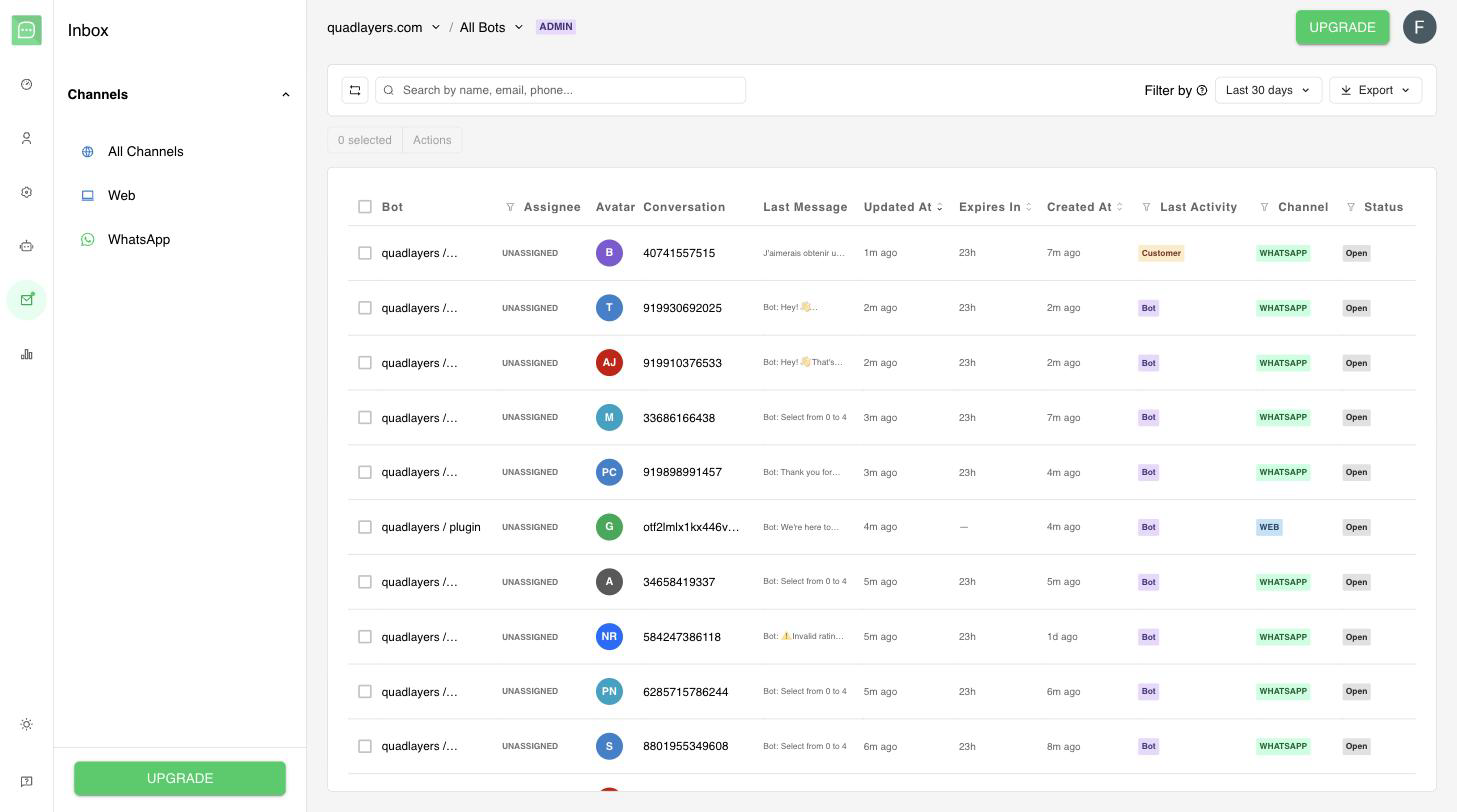
Quick.Bot’s shared inbox: assign live conversations to agents across WhatsApp and web from one place.

Figure: The four stages of a reliable chatbot-to-human handoff.
When should a chatbot hand off to a human?
A chatbot should hand off on clear signals, not guesses. The most reliable triggers are: the customer explicitly asks for a person; the bot’s confidence in the last few turns is low or it repeats a fallback; sentiment turns negative or frustrated; the request is high-value (a large order, a churn risk, a legal or billing issue); or the flow reaches a step that policy says a human must own. Combine an explicit “talk to a human” option with automatic triggers so you catch both the customers who ask and the ones who silently struggle.
How do you pass full context in a handoff?
You pass full context by transferring the complete transcript, the captured variables, and the current flow position — not just a “handoff requested” flag. The agent must open the conversation already knowing who the customer is, what they asked, what the bot collected, and where they are in the flow. The test is simple: if the agent’s first message has to be “Can you tell me what this is about?”, the context transfer failed. When the bot and the inbox are separate systems, context is only as complete as the integration you built between them; a native inbox carries the whole conversation by default.
Here is how it looks in Quick.Bot: when a flow escalates, the conversation is transferred to the right agent with full context, the agent gets assignment and ownership of that thread, and the bot pauses automatically so it does not talk over the human. No separate inbox to wire up.
What role do queues and routing play?
Queues and routing make sure a conversation reaches the right human, in order, without getting lost. Handing off “to a human” is not enough; you hand off to the right human. Routing sends the conversation to the agent or team best suited to it, based on topic, language, priority, or availability. Assignment then gives one agent ownership so the conversation is not left in a shared pile that everyone sees and no one answers. A queue holds conversations that arrive faster than agents can pick them up, in a predictable order, so nothing is lost at peak times.
What SLA should a handoff have?
A handoff SLA is your promise for time-to-first-response once a conversation reaches the queue. Set a target you can actually meet at peak, measure it, and make the queue visible so waiting conversations are not invisible. WhatsApp raises the bar because people read it like a personal conversation, so silence reads as being ignored rather than as a ticket in a queue. A tight, measured first-response target matters more than a generous one you miss. Track handoff rate and first-response time together; a rising handoff rate with a slipping SLA is the early warning that your bot is escalating more than your team can absorb.
How should reassignment work?
Reassignment should keep a single clear owner at every moment and carry the full history along, so the next agent is as informed as the first. Conversations do not always end with the first agent — shift changes, escalations to a specialist, and follow-ups all require passing ownership. Without clear ownership, reassigned conversations are the ones that get dropped between people.
When is a manual, lightweight handoff enough?
A manual, lightweight handoff is enough when you handle low volume and can coordinate informally. A single “talk to a human” button that pings one shared inbox may be perfectly adequate, and adding routing and SLA machinery would be overkill. The structured approach earns its keep as volume, team size, and response-time expectations grow. Start simple, and add triggers, routing, and SLAs when you feel conversations slipping through.
Frequently asked questions
What is chatbot-to-human handoff?
It is the process of a chatbot transferring an active conversation to a human agent, ideally with full context, so the person can continue seamlessly. A complete handoff also pauses the bot so it does not reply over the agent.
When should a chatbot escalate to a human?
Escalate when the customer asks for a person, when the bot’s confidence is low or it loops, when sentiment turns negative, or when the request is high-value or policy-bound. Pair an explicit request option with automatic triggers to catch both.
How do you keep context during handoff?
Transfer the full transcript, the collected variables, and the current flow position to the agent, not just a handoff flag. If the agent has to ask the customer to repeat themselves, the context transfer was incomplete.
What is a good SLA for chatbot handoff?
A good SLA sets a specific time-to-first-response for queued conversations, one you can meet at peak, and measures it continuously. On WhatsApp, a tight and reliably met target beats a generous one you miss.
Does the bot stop when a human takes over?
It should. In a proper handoff the bot pauses the instant the conversation moves to a human, so the two never reply over each other. In Quick.Bot that happens on its own — whether the flow hands off or an agent takes the conversation over from the inbox.
Conclusion
A handoff that works is not one feature but six: the right trigger, full context, correct routing with clear ownership, a bot-pause, a measured SLA, and clean reassignment. Whether you assemble this from separate tools or use a platform that handles it natively, the principles are the same. Quick.Bot’s WhatsApp bot builder covers all six in one product. For the WhatsApp-specific playbook and the tools involved, see our complete guide to chatbot-to-human handoff on WhatsApp.
Get triggers, context transfer, assignment, and auto-pause in one platform. See the native inbox →