By Francisco Mastromarino, Founder, Quick.bot · June 29, 2026
Do You Still Need Chatwoot With Typebot for Human Handoff?
Key takeaways
- Typebot builds the bot; it has no shared agent inbox, so live human handoff on WhatsApp needs a second tool such as Chatwoot.
- The common fix is Typebot + Chatwoot (often + Evolution API on WhatsApp) — three systems you wire, host, and keep in sync yourself.
- The handoff is glue you own: context transfer, bot-pause, and state sync between the two tools are your responsibility, not a built-in feature.
- Quick.Bot is an alternative that combines the flow builder and a native shared inbox in one product, so handoff, assignment, and bot-pause happen with no integration layer.
- WhatsApp reached 3 billion monthly active users in 2025 (Meta), which is why reliable human handoff on that channel matters most.
Typebot + Chatwoot vs an all-in-one, at a glance
Below: what each setup gives you, cell by cell.
| Capability | Typebot alone | Typebot + Chatwoot | Quick.Bot |
|---|---|---|---|
| Visual flow builder | ✅ | ✅ (Typebot) | ✅ |
| Shared team inbox | ❌ | ✅ (Chatwoot) | ✅ native |
| Human handoff with full context | ⚠️ depends on your mapping | ⚠️ depends on integration | ✅ full context, native |
| Bot auto-pauses when agent joins | ❌ manual | ⚠️ via status change | ✅ automatic on assignment |
| Systems to run | 1 | 2–3 (often + Evolution API) | 1 |
| Who maintains the handoff glue | — | You | Built in |
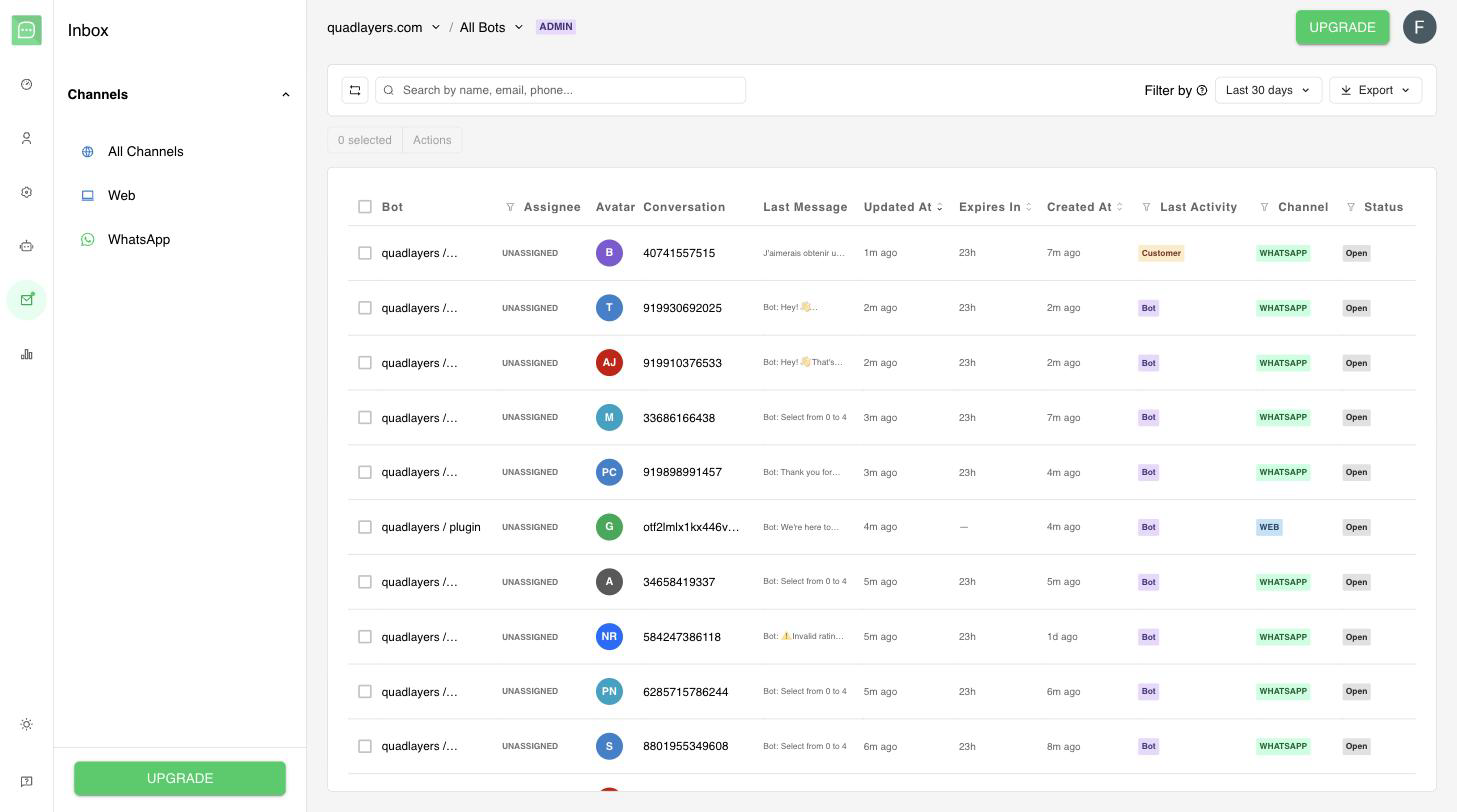
Quick.Bot’s shared inbox: assign live conversations to agents across WhatsApp and web from one place.

Figure: One WhatsApp message crosses three systems before a human can reply.
What is the Typebot + Chatwoot stack?
The Typebot + Chatwoot stack is a three-part setup that pairs a bot builder with an agent inbox. Typebot runs the conversational flow. Chatwoot provides the shared inbox where human agents reply. On WhatsApp specifically, many teams add a gateway such as the open-source Evolution API to connect one number to both tools. Messages flow from WhatsApp into the gateway, the bot answers first, and when a person is needed the conversation is handed to a Chatwoot agent.
Chatwoot supports this through its agent-bot model. According to Chatwoot’s documentation:
“When an agent bot is connected to an inbox, conversations are created with a ‘pending’ status, allowing it to triage the conversation before passing it on to a human agent.”
The bot then changes the status to open to release the conversation to a human. It is a real, workable design used by many teams — across just two conversation states, pending and open.
Does Typebot have a built-in agent inbox?
No. Typebot is an open-source conversational form and chatbot builder, not a help desk. It does not ship a shared inbox where multiple human agents pick up, own, and reply to live conversations. That is exactly the gap Chatwoot fills, which is why the two are so often paired. If your bot only collects answers and never hands off to a person, you may not need Chatwoot at all. The moment you want live human replies, you need an inbox from somewhere.
What breaks in the Typebot + Chatwoot handoff?
Three things tend to hurt as volume grows.
Lost or partial context. The bot knows the customer’s name, their answers, and their flow position. The inbox only knows what your integration passes across. If the mapping is thin, the agent opens a conversation with little history and has to ask the customer to repeat themselves.
Double infrastructure. You are now running and updating at least two systems, often three with a WhatsApp gateway. Each has its own hosting, upgrades, backups, and failure modes. An outage or version mismatch in any one of them can break the whole flow.
Bot and agent state sync. The hardest part is making the bot go quiet the instant an agent takes over and resume correctly afterward. If the status signal is missed, the bot and the human reply over each other in the same thread, which reads as broken to the customer.
If your team spends more time maintaining the connection between bot and inbox than improving the conversations, the glue is no longer worth it. Quick.Bot was built to remove that layer: the bot and the inbox are one product, so a conversation transfers to the right agent with full context and the bot pauses on its own — whether the flow hands off or an agent takes the conversation over.
When is Typebot + Chatwoot the better choice?
Typebot + Chatwoot is the better choice when you want open-source control and have the engineering time to run it. If you are already self-hosting and want full ownership of your data and infrastructure, the open-source stack gives you that. If you value being able to modify both tools, Typebot and Chatwoot are mature, flexible, and free to run on your own servers. And if you already have Chatwoot deployed for email, web chat, and other channels, adding Typebot as the bot layer can be the pragmatic move rather than replacing a working help desk. The trade-off is always the same: more control in exchange for more systems to run and more glue to maintain.
Frequently asked questions
Can Typebot hand off to a human agent?
Typebot itself does not include a human inbox, so it hands off by passing the conversation to an external tool such as Chatwoot. Chatwoot then provides the agent inbox and, through its agent-bot handoff, changes the conversation status to open and stops the bot from responding once an agent takes over.
Do I need Evolution API for Typebot and Chatwoot on WhatsApp?
Not always, but many self-hosted setups use a WhatsApp gateway like Evolution API to connect one WhatsApp number to both the bot and the inbox. It adds a third system to run. Using the official WhatsApp Cloud API through a provider avoids the unofficial-gateway path.
How does the bot know to stop when an agent joins?
In the Typebot + Chatwoot pattern, the conversation status changes on handoff and the bot stops responding to open conversations. You are responsible for wiring that signal correctly so the bot does not talk over the agent.
Is there a single tool that does both the bot and the inbox?
Yes. Quick.Bot combines a visual flow builder and a native shared team inbox in one product, so handoff, assignment, and bot pausing happen without an integration between separate systems.
Will I lose conversation context during handoff?
With Typebot plus Chatwoot, the agent sees only the context your integration passes across, so partial mappings lead to lost history. A native handoff carries the full conversation, so the agent picks up where the bot left off.
Conclusion
Typebot and Chatwoot are both strong open-source tools, and together they can deliver bot-plus-inbox on WhatsApp. The cost is real: two or three systems, an integration you own, and the constant job of keeping bot and agent state in sync. If you want the native path instead, Quick.Bot’s WhatsApp bot builder puts the builder, inbox, and auto-handoff in one product. For the full picture of triggers, context transfer, and SLAs, see our complete guide to chatbot-to-human handoff on WhatsApp.
Get the bot builder, inbox, and native handoff in one platform. See the native inbox →