By Francisco Mastromarino, Founder, Quick.bot · August 4, 2026
ManyChat Alternative for WhatsApp: The Pricing Math at 1K, 5K and 20K Conversations
Key takeaways
- ManyChat prices its platform fee primarily by number of contacts, so on WhatsApp your bill grows with your audience — separate from Meta’s own messaging fees.
- Prices below were verified in August 2026. Vendors change them often — ManyChat restructured in 2026 — so confirm on each pricing page before deciding.
- Quick.Bot is the highlighted alternative: it bundles builder + native inbox + in-flow payments, and bills by conversation, not by contact — so a large-but-quiet list is not what you pay for. Plans run $49/mo (Starter, 1,000 conversations) and $99/mo (Grow, 3,000 conversations, 3 seats), with a free tier and a 14-day trial without a card. Verified August 2026 — check current pricing.
- Separate the two cost layers: the platform fee (differs by tool) and Meta’s WhatsApp fee (roughly the same on any tool using the official Cloud API).
- Since July 1, 2025 Meta moved from conversation-based pricing to per-delivered-message billing by category and country, so “conversation volume” is now a proxy, not the billing unit. Rates differ per country and category, so look yours up in Meta’s pricing docs.
What are the two costs you must separate?
Every WhatsApp automation bill has two layers, and mixing them up is the most common budgeting mistake.
- Platform fee — what the software vendor charges (ManyChat, Quick.Bot, Landbot). This is where pricing models differ: per-contact vs flat tier vs your own infra.
- Meta WhatsApp fee — what Meta charges for messages through the official Cloud API. As of July 1, 2025 this is billed per delivered template message, by category and recipient country, and applies no matter which platform you use. A vendor cannot make it disappear.
When you compare a ManyChat alternative, compare layer 1. Layer 2 is roughly the same across any tool on the official Cloud API.
Comparison of ManyChat alternatives by pricing model and list price. Prices verified August 2026 — vendors change them often, so confirm before you commit.
| ManyChat | Quick.Bot | Landbot | Typebot (self-host) | Botpress | |
|---|---|---|---|---|---|
| Primary pricing driver | Active contacts/mo | Conversations/mo | Chats/mo + seats | Your infra cost | Usage (AI spend) |
| Free trial / tier | Free tier | Free tier + 14-day trial, no card | Sandbox: 100 chats/mo | Free to self-host | Free plan + $5/mo AI credit |
| Built-in shared inbox | ⚠️ Live Chat — 2 seats on Pro, extra $25 each | ✅ Native | ⚠️ Agent layer | ❌ Add Chatwoot | ❌ |
| In-flow payments | ⚠️ Via integration | ✅ Stripe + Mercado Pago | ⚠️ Via integration | ⚠️ Stripe block | ❌ |
| Official WhatsApp Cloud API | ✅ | ✅ Embedded signup | ✅ | ✅ | ✅ |
| Meta per-message fee applies | ✅ (all tools) | ✅ (all tools) | ✅ | ✅ | ✅ |
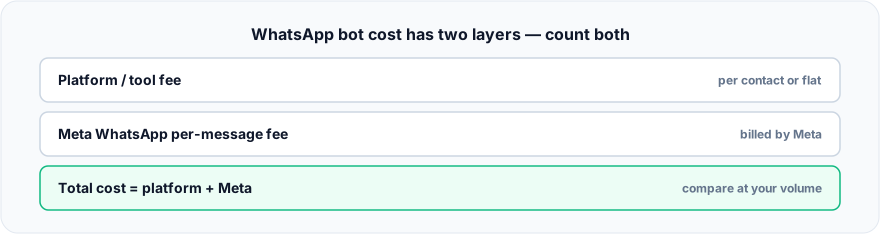
Figure: WhatsApp bot cost has two layers — count both.
Verified August 2026 — confirm on each vendor’s live pricing page before committing. ✅ native · ⚠️ add-on · ❌ not available.
What is the real pricing math at 1K, 5K and 20K conversations?
Because published numbers move, the method matters more than any figure: count both layers separately, then plug in each vendor’s current price. The diagram shows the logic before the numbers.
At ~1,000 conversations/month
- Meta layer: ~1,000 conversations map to delivered messages × Meta’s per-message rate for your country and category. Same for every platform.
- ManyChat layer: driven by how many contacts those conversations represent — ManyChat bills by active contacts, not conversations, so a small list may fit an entry tier.
- Quick.Bot layer: Starter at $49/mo covers 1,000 conversations with the inbox included; beyond that you either move up a tier or pay $0.02 per extra conversation.
- Takeaway: at low volume the platform fee is small on both; Meta fees dominate.
At ~5,000 conversations/month
- Meta layer: ~5,000 conversations × your per-message rate. Same everywhere.
- ManyChat layer: contact count is usually well past the entry cap, so you move up a tier and/or pay per-contact overage — on Pro that is 2,500 active contacts included, then $0.05 per extra contact monthly ($0.038 annual). A per-contact model climbs fast when your list is bigger than your active conversations.
- Quick.Bot layer: Grow at $99/mo includes 3,000 conversations and 3 seats; the remaining ~2,000 bill at $0.012 each, so roughly $123/mo — inbox and payments still bundled. Note this is a conversation count, not a contact count.
- Takeaway: compare contacts vs active conversations. If you accumulate contacts who don’t chat every month, per-contact pricing charges for them; a plan priced on tier/usage may not.
At ~20,000 conversations/month
- Meta layer: ~20,000 × your rate, plus category mix. This is now the biggest line item.
- ManyChat layer: higher tier plus overage on a large contact base well past the Pro tier’s 2,500 included contacts, so overage or a custom plan applies.
- Quick.Bot layer: past the published tiers this is the Done For You plan — custom conversation and seat limits, quoted rather than listed.
- Takeaway: at scale the questions are (a) per contact or per tier, and (b) do you buy a separate inbox/live-chat add-on on top. A bundled inbox + payments can remove a second line item.
Do the math with real numbers before you commit. The volume where a per-contact tool overtakes a tier-based tool depends entirely on your contact-to-conversation ratio — there is no universal crossover point.
What are the best ManyChat alternatives for WhatsApp?
Quick.Bot — bundled builder + inbox + payments (highlighted)
Best for: WhatsApp-first teams whose contact list is larger than their active conversations, who want one plan covering the bot and the human desk. Standout: native shared inbox, auto-pausing handoff, per-block analytics, and in-flow payments (Stripe + Mercado Pago) — so no separate live-chat purchase. 14-day free trial, no card. Honest downside: managed cloud only, no self-hosting; WhatsApp-first with Web and Telegram (Instagram, TikTok and email are announced, not yet shipped), not a social-marketing suite. Pricing (verified August 2026): free tier (100 conversations, no WhatsApp); Starter $49/mo for 1,000 conversations and 1 seat; Grow $99/mo for 3,000 conversations and 3 seats; extra seats $12–15/mo, extra conversations $0.012–0.02 each; Done For You is quoted. See current pricing.
Landbot — no-code builder with WhatsApp campaigns
Best for: marketing and sales teams wanting a polished WhatsApp builder plus an agent layer. Standout: hybrid AI + rule-based flows and native WhatsApp campaign sending. Honest downside: pricing can scale on contacts and seats, so a large audience raises the platform fee much like ManyChat’s model does. Pricing (verified August 2026): free Sandbox (100 chats/mo, 1 seat); Starter $45/mo (500 chats, 2 seats); Pro $110/mo (2,500 chats, 3 seats); WhatsApp Pro $220/mo (2,500 chats + 10,000 WhatsApp service messages, 3 seats) — WhatsApp is not on the cheaper tiers. Extra seats $25/mo each.
Typebot (self-hosted) — lowest platform fee, most work
Best for: teams with engineering capacity that want the smallest software bill and full data ownership. Standout: free to self-host — the platform fee is your infrastructure, not a per-contact charge. Honest downside: no built-in inbox (add Chatwoot) and you own hosting, updates, backups and uptime. The software license is $0; your real bill is VPS + object storage + SMTP + backups + the engineering hours, so price those four line items with your own providers before comparing. Typebot Cloud, if you would rather not self-host, is $39/mo (2,000 chats, 2 seats) or $89/mo (10,000 chats, 5 seats), verified August 2026.
Botpress — AI-agent alternative
Best for: dev-led teams building LLM-driven agents rather than fixed flows. Standout: LLM-native architecture, TypeScript SDK, knowledge-base RAG. Honest downside: usage-based pricing tied to AI spend can be unpredictable, and it has no native support inbox. Botpress runs a free plan with a $5/month AI-spend credit and then meters usage — LLM costs are passed through without markup, and since its May 2026 update each conversation you buy carries a proportional AI quota. Predicting the bill means predicting your token usage.
If your bill is climbing because you pay for contacts and a separate live-chat tool, an all-in-one builder with the inbox included (like Quick.Bot) collapses two line items into one.
When is ManyChat still the better choice?
ManyChat is the better choice when your primary channel mix is Instagram and Messenger, not just WhatsApp — it is one of the strongest tools for Instagram DM automation, comment-triggered flows, and creator/marketing growth mechanics. If your business runs on social-media audience growth and broadcast campaigns, ManyChat’s feature depth and per-contact model are built for exactly that. Quick.Bot is WhatsApp-first, with Web and Telegram today and Instagram, TikTok and email channels announced for release; if Instagram automation is your core use case rather than an add-on, ManyChat is the stronger fit today.
Frequently asked questions
How much does ManyChat cost for WhatsApp?
ManyChat prices its platform fee primarily by number of contacts, with a free tier and paid plans that scale as your list grows. On the Pro plan that is 2,500 active contacts included, then $0.05 per extra contact monthly ($0.038 on annual billing), with 2 inbox seats and $25 per additional seat. ManyChat restructured its pricing in 2026, so check the live page. Separately, Meta charges its own per-message WhatsApp fee on any platform.
What is the cheapest ManyChat alternative for WhatsApp?
It depends on your contact-to-conversation ratio. Self-hosting an open builder like Typebot has the lowest platform fee but you run the infrastructure and add a separate inbox, so price VPS, storage, SMTP and your own hours before calling it cheaper. Quick.Bot bundles builder, inbox and payments from $49/mo.
Does ManyChat charge per contact or per conversation?
ManyChat’s platform fee is driven primarily by contacts, not conversations. That is different from Meta’s WhatsApp fee, which since July 1, 2025 is charged per delivered message. This is why two businesses with the same conversation volume can have very different ManyChat bills.
Do I still pay Meta’s WhatsApp fees on an alternative platform?
Yes. Meta’s WhatsApp Cloud API fee applies regardless of which software you use, because it is charged by Meta, not the platform. Since July 1, 2025 it is billed per delivered template message by category and country. Any vendor claiming to eliminate it should be treated with caution.
Does Quick.Bot support WhatsApp payments?
Yes, on the paid plans. Quick.Bot supports in-flow payments through Stripe and Mercado Pago, so a customer can pay inside the WhatsApp conversation. This can consolidate a checkout step that would otherwise need a separate tool.
Is there a free way to try a ManyChat alternative?
Yes. Quick.Bot offers a 14-day free trial with no credit card required. Open-source options like Typebot are free to self-host if you are comfortable running the infrastructure yourself — at the cost of running and maintaining it.
Conclusion
The right ManyChat alternative for WhatsApp depends on one number you already have: your contact-to-conversation ratio. Per-contact pricing rewards small, active lists and penalizes large, quiet ones. Before you switch, separate Meta’s per-message fee from the platform fee, plug each vendor’s current numbers into the 1K/5K/20K framework above, and check whether a shared inbox is included or an extra line item. If you want the builder, native inbox and payments in one plan, see how Quick.Bot’s WhatsApp builder is packaged, and compare it against an inbox-first Typebot alternative.
Compare the real numbers — Try Quick.Bot free →