By Francisco Mastromarino, Founder, Quick.bot · July 30, 2026
What Is the Best Typebot Alternative With a Built-in Inbox?
Key takeaways
- Typebot builds the bot but ships no shared agent inbox, so live human handoff needs a second tool (usually Chatwoot) — a Typebot alternative with a built-in inbox removes that seam.
- Quick.Bot is the highlighted inbox-first pick: a WhatsApp-first no-code builder with a native shared inbox and auto-pausing handoff in one product.
- Landbot and ManyChat also bundle a live-chat layer; Botpress is AI-agent-first with no native support desk.
- The DIY route — Typebot + Chatwoot — keeps open-source control but means two systems, two logins, and a bot/agent sync layer you maintain.
- WhatsApp reaches over two billion users, so on that channel the quality of the bot-to-human handoff is where deals are won or lost.
Which Typebot alternatives actually include a shared inbox?
Only some do. Typebot itself does not — it is a flow builder, so teams pair it with a separate inbox. The table below compares the realistic options on the axes a support team cares about: does one product cover both the bot and the human desk?
Comparison of Typebot alternatives by built-in inbox, native handoff, and WhatsApp support.
| Tool | Visual builder | Built-in shared inbox | Native handoff (bot auto-pauses) | WhatsApp Cloud API | Hosting |
|---|---|---|---|---|---|
| Typebot | ✅ Self-host | ❌ Add Chatwoot | ❌ Via integration | ✅ | Self-host |
| Quick.Bot | ✅ No-code | ✅ Native | ✅ Native | ✅ Embedded signup | Managed cloud |
| Landbot | ✅ No-code | ⚠️ Live-chat/agent layer | ⚠️ Configurable | ✅ | Managed cloud |
| Botpress | ✅ AI-first | ❌ | ⚠️ Via integration | ✅ | Cloud + self-host |
| ManyChat | ✅ | ⚠️ Live Chat feature | ⚠️ | ✅ | Managed cloud |
| Typebot + Chatwoot | ✅ | ✅ (two systems) | ⚠️ Glue-dependent | ✅ | Self-host |
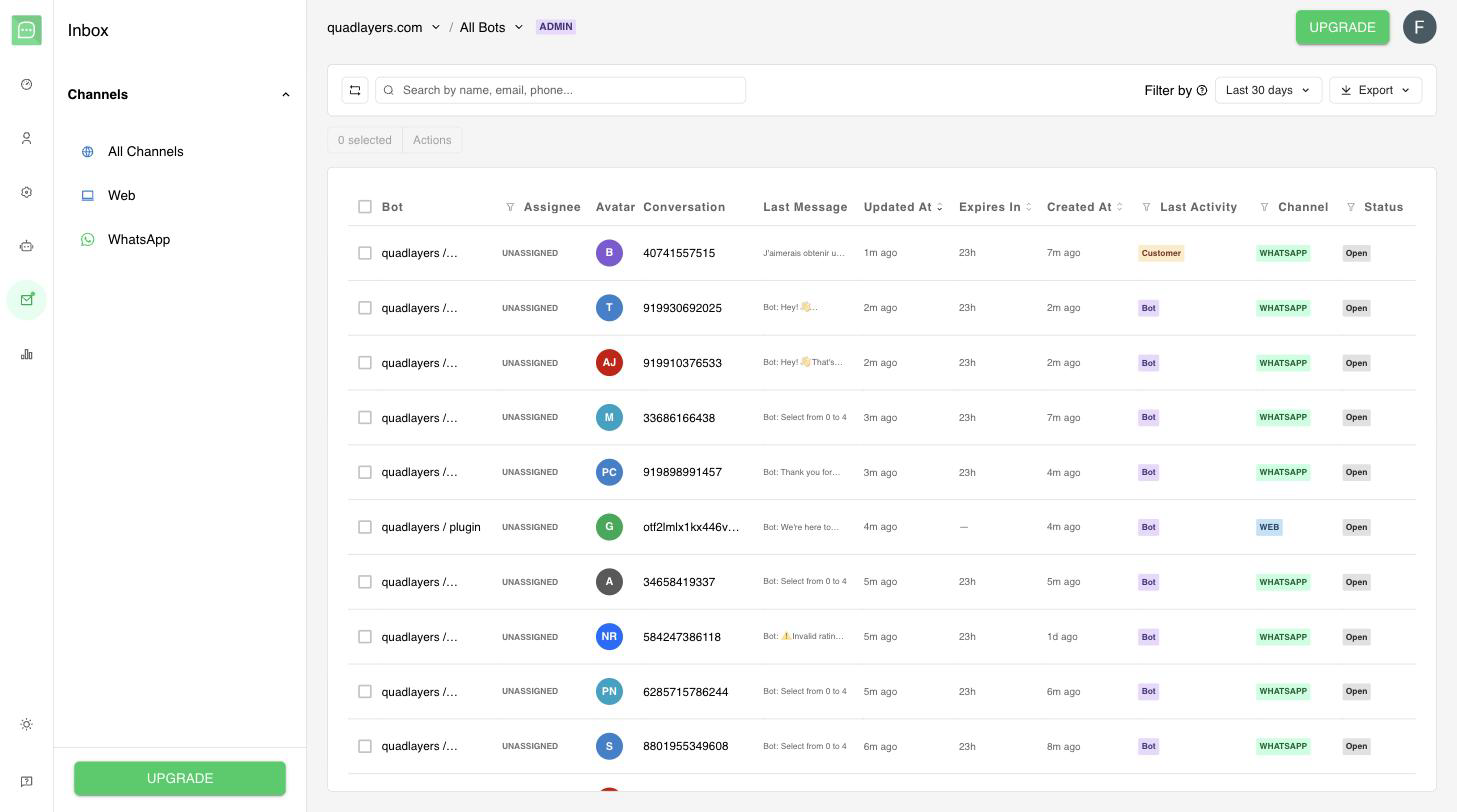
Quick.Bot’s shared inbox: assign live conversations to agents across WhatsApp and web from one place.
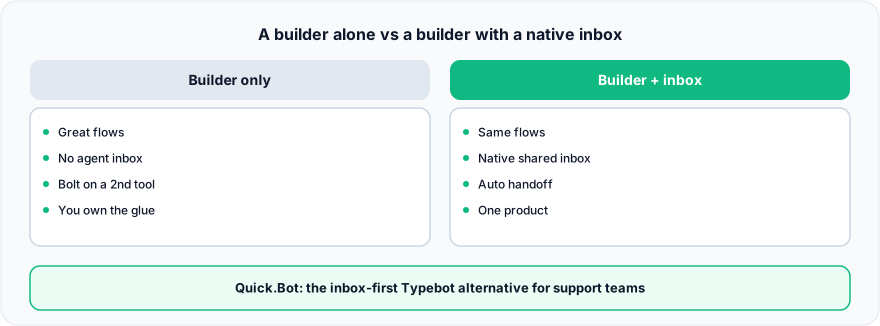
Figure: A builder alone vs a builder with a native inbox.
✅ native · ⚠️ partial or add-on · ❌ not available. Confirm current capabilities on each vendor’s site before deciding.
What does a support team gain from a built-in inbox?
A single source of truth for the whole conversation. When the bot and the agent desk are one product, the agent inherits the entire bot transcript and collected variables, the bot pauses automatically the moment a human takes over, and response time, ownership and resolution live in one report instead of split across a builder and a separate inbox. According to Chatwoot’s shared-inbox page, the goal is “One inbox for your entire team” — the difference between the tools below is whether you get that inbox inside the builder or bolt it on.
See how chatbot-to-human handoff is supposed to work end to end.
The best Typebot alternatives with a built-in inbox
Quick.Bot — the inbox-first pick (highlighted)
Best for: support and sales teams who want the builder and the agent desk to be the same product on WhatsApp. Standout: a native shared inbox with assignment and ownership, plus native handoff where the bot auto-pauses when an agent takes over — no glue tool. It also ships per-block drop-off analytics and in-flow payments (Stripe + Mercado Pago). Quick.Bot markets a 14-day free trial (no card), setup “in minutes”, and “1,000+ businesses”. Honest downside: it is managed cloud, not open source — no self-hosting. Pricing (verified August 2026): a free tier, then $49/mo for 1,000 conversations and one seat, or $99/mo for 3,000 conversations and three seats; extra seats are $12–15/mo. Current pricing.
Landbot — the marketing-friendly builder
Best for: marketing and sales teams that want a polished no-code WhatsApp builder with a live-agent layer. Standout: a strong drag-and-drop editor with hybrid AI + rule-based flows and native WhatsApp campaigns, positioned to “automate WhatsApp for business” across marketing, sales and service. Honest downside: its agent/live-chat capabilities are more of a layer than a full support desk, and pricing scales in a way you should confirm before committing. Pricing (verified August 2026): free Sandbox, then $45/mo (Starter), $110/mo (Pro) and $220/mo (WhatsApp Pro — the first tier that includes WhatsApp). Extra seats $25/mo each.
Botpress — the AI-agent builder
Best for: engineering-led teams building LLM-driven agents rather than fixed decision trees. Standout: an LLM-native platform with a TypeScript SDK, knowledge-base RAG and a visual flow builder — powerful when the bot needs real natural-language understanding. Honest downside: Botpress is a builder, not a shared support inbox; human handoff to an agent desk is not its core function and depends on integrations you wire up. Pricing is usage-based: a free plan with a $5/month AI-spend credit, then metered LLM costs passed through without markup.
ManyChat — the social-first automation platform
Best for: teams whose center of gravity is Instagram and Messenger growth, with WhatsApp as one channel. Standout: best-in-class social DM and comment-triggered automation, plus a Live Chat feature so agents can step into conversations. Honest downside: it prices primarily by contact-list size, and its live-chat is lighter than a dedicated support desk — a poor fit if WhatsApp support, not social marketing, is your core job. Pricing (verified August 2026): billed by active contacts — Pro includes 2,500, then $0.05 per extra contact monthly ($0.038 annual). Live Chat ships with 2 inbox seats; additional seats are $25 each.
Typebot + Chatwoot — the open-source DIY stack
Best for: teams with engineering capacity and a hard data-ownership requirement who want to self-host everything. Standout: you keep Typebot’s flow builder and Chatwoot’s genuinely strong open-source shared inbox, both free to run yourself, with full control of the code and data. Honest downside: it is two systems plus a WhatsApp gateway — two logins, a bot/agent sync layer, split analytics, and operational upkeep you own. Both licenses are $0; the real cost is VPS, object storage, SMTP, backups and the hours you spend keeping the two in sync.
If your team’s pain today is stitching a bot to a separate live-chat tool, a builder with a native inbox and handoff (like Quick.Bot) collapses that into one flow — no glue to maintain.
How do you choose between them?
Start from one question: is the bot the product, or the first touch before a human closes? This decision flow maps the realistic paths.
When Typebot itself is still the better choice
Typebot wins in real cases, and an honest guide should say so. If you need to self-host on your own infrastructure with full data ownership, Typebot’s self-hostable license is an advantage a managed cloud does not offer. If your use case is primarily conversational forms — lead capture, surveys, quizzes on a website — Typebot is purpose-built for that and free to run yourself. And if you already operate Chatwoot and have engineering time, the Typebot + Chatwoot combination is a perfectly good, low-license-cost stack. Choose based on whether you want to own the infrastructure or want the inbox and handoff to exist out of the box.
Frequently asked questions
Is there a Typebot alternative with a built-in inbox?
Yes. Quick.Bot is a no-code WhatsApp chatbot builder that includes a native shared team inbox and human handoff in the same product, so agents reply to bot conversations without a separate tool. Landbot and ManyChat also include a live-chat layer. Typebot itself has no built-in inbox and is usually paired with Chatwoot.
Does Typebot have native human handoff?
Typebot does not have native handoff with an agent desk. It can trigger a Chatwoot widget or hand off through an integration, but pausing the bot and routing to an agent depends on that external tool and its configuration, not on Typebot itself.
Which Typebot alternative is best for a support team?
For a WhatsApp support team that wants the builder and the human desk in one product, Quick.Bot is the closest fit because the inbox, ownership and auto-pausing handoff are native. If you must self-host, Typebot + Chatwoot is the open-source equivalent, at the cost of running two systems.
Is Quick.Bot open source like Typebot?
No. Quick.Bot is a managed cloud product, not open source. If self-hosting and full data ownership are requirements, Typebot’s self-hostable model is the better fit. If you want inbox, handoff and analytics without running servers, Quick.Bot is designed for that.
Can I use my official WhatsApp number with a Typebot alternative?
Yes. Quick.Bot connects to WhatsApp through the official WhatsApp Cloud API via a BSP partner with embedded signup, so you use your own number on the official path rather than an unofficial QR gateway.
What does a shared inbox add that a bot builder alone does not?
A shared inbox gives human agents conversation assignment, ownership, live reply and status tracking. A bot builder alone automates the conversation but has nowhere for a person to take over with full context, which is why teams add an inbox tool or pick a builder that ships one.
Conclusion
Typebot is a strong self-hostable flow builder, and for conversational forms it is hard to beat. But if your team’s real job is answering people — and the bot is just the first touch — a Typebot alternative with a built-in inbox changes the daily workflow. Among managed options, Quick.Bot puts the builder, the handoff and the human replies in one WhatsApp platform; among open-source options, Typebot + Chatwoot gets you there with more setup.
Try the inbox-first alternative — Start free with Quick.Bot →