By Francisco Mastromarino, Founder, Quick.bot · July 31, 2026
Open-Source WhatsApp Chatbot Builders Compared: Builder, Inbox and Analytics
Key takeaways
- No single open-source project does all three jobs well — building the flow, running a shared inbox for agents, and giving drop-off analytics; you assemble them.
- Typebot is the strongest self-hostable flow builder, Botpress the strongest for AI agents, and Chatwoot the strongest open-source shared inbox — each excellent on one axis.
- The classic self-hosted stack is Typebot + Chatwoot + a WhatsApp gateway: real control, but three services, a sync layer and split analytics to maintain.
- Quick.Bot is the honest managed exception: it covers builder + inbox + per-block analytics in one product, at the cost of not being open source. Paid plans start at $49/mo (verified August 2026).
- Any tool on the official WhatsApp Cloud API still pays Meta’s per-message fee (per-message billing since July 1, 2025) — open source lowers software cost, not Meta’s charges. Meta publishes the rates per country and category.
What three axes should you judge these tools on?
Builder, inbox, and analytics — most comparisons lump these together, but they are separate jobs.
- Builder — can a non-developer design and edit the conversation flow visually?
- Inbox — when a human takes over, is there a shared agent desk with assignment and ownership?
- Analytics — can you see completion rate and the exact block where users abandon?
A tool can be excellent on one axis and absent on another. That is the whole point.
Open-source WhatsApp chatbot builders compared across builder, inbox and analytics.
| Tool | Builder | Inbox | Analytics | License / hosting |
|---|---|---|---|---|
| Typebot | ✅ Visual flow builder | ❌ Add Chatwoot | ⚠️ Basic results | Source-available, self-host |
| Botpress | ✅ AI-first flow builder | ❌ | ⚠️ Varies by setup | Open source core, self-host + cloud |
| Chatwoot | ❌ Not a bot builder | ✅ Strong shared inbox | ⚠️ Support metrics | Open source (MIT), self-host |
| Typebot + Chatwoot | ✅ | ✅ (two systems) | ⚠️ Split across tools | Open/source-available, self-host |
| Quick.Bot | ✅ Visual, no-code | ✅ Native inbox | ✅ Per-block drop-off | Managed cloud (not OSS) |
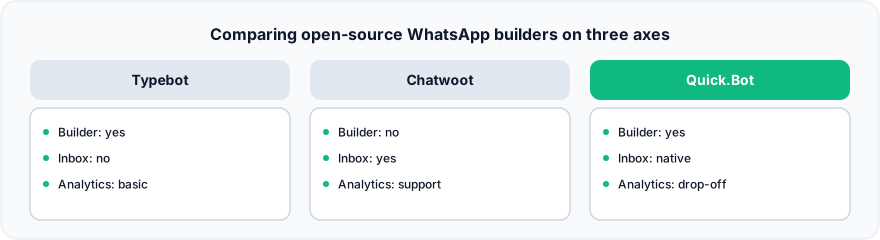
Figure: Comparing open-source WhatsApp builders on three axes.
✅ strong · ⚠️ partial · ❌ not its job. Confirm current capabilities and license on each project’s site.
Which open-source WhatsApp chatbot builder fits which job?
Typebot — the builder axis
Best for: teams that want a clean, self-hostable visual flow builder for WhatsApp and web. Standout: a drag-and-drop editor with 45+ blocks; its own docs describe it as “a fair source chatbot builder” you can self-host and deploy to a WhatsApp number. Honest downside: no agent inbox and only basic built-in results — you add Chatwoot for the human layer and an external tool for real funnels. Pricing (verified August 2026): self-hosting the software is free; Typebot Cloud is $39/mo (2,000 chats, 2 seats) or $89/mo (10,000 chats, 5 seats).
Botpress — the AI-agent axis
Best for: engineering-led teams whose bot needs LLM behavior, not a fixed decision tree. Standout: an MIT-licensed, LLM-native platform with a TypeScript SDK, knowledge-base RAG and a visual builder. Honest downside: it is a builder, not a support inbox; handoff to a shared agent desk is not its core function, and analytics depend on how you wire it. Botpress has a free plan with a $5/month AI-spend credit and then meters usage, passing LLM costs through without markup — so the bill tracks your token consumption.
Chatwoot — the inbox axis
Best for: teams that already have a bot and need a strong open-source agent desk. Standout: an omnichannel shared inbox — Chatwoot’s own tagline is “One inbox for your entire team” — with assignment, ownership, SLAs and CSAT, self-hostable under MIT. Honest downside: Chatwoot is not a bot builder; you bring the bot from elsewhere, and its reports are support metrics, not chatbot-flow funnels. Pricing (verified August 2026): the Community Edition is free to self-host; Chatwoot Cloud runs $0/agent (Hacker, 2 agents, 500 conversations), $19/agent/mo (Startups), $39/agent/mo (Business) and $99/agent/mo (Enterprise), billed annually.
Typebot + Chatwoot — the classic self-hosted stack
Best for: teams with engineering capacity and a hard data-ownership requirement who want the whole thing on their own servers. Standout: you combine the best open builder and the best open inbox, both free to run, with full control of code and data. Honest downside: three moving parts (builder + inbox + WhatsApp gateway), a bot/agent sync layer, and analytics split across two tools — all operational cost you own. The licenses are $0; the bill is VPS + object storage + SMTP + backups, plus the engineering hours nobody invoices you for.
Quick.Bot — the managed all-in-one (highlighted)
Best for: teams that want builder + inbox + drop-off analytics behind one login and will trade self-hosting for that. Standout: a no-code WhatsApp builder with a native shared inbox, auto-pausing handoff, per-block drop-off analytics and in-flow payments — the three axes in one product; markets 14-day free trial (no card) and “1,000+ businesses”. Honest downside: managed cloud, not open source — no self-hosting or code-level customization. Pricing (verified August 2026): free tier, then $49/mo (1,000 conversations) and $99/mo (3,000 conversations, 3 seats) — current pricing.
Why do teams end up self-hosting three tools?
Because no single open-source project spans all three axes. The common self-hosted WhatsApp stack becomes a builder (Typebot or Botpress) + an inbox (Chatwoot) + a WhatsApp gateway. It works, and for teams with engineering time and a data-ownership requirement it is a legitimate, low-license-cost architecture.
The hidden costs show up in operation: you maintain multiple services, keep bot state and agent state in sync, and reconcile analytics that live in two tools. When a conversation crosses the seam between the bot and the inbox, context and history are the first things to break. We break down the real bill in the self-hosted Typebot cost checklist.
What about analytics and drop-off?
This is the weakest axis across the open-source options. Typebot’s built-in results are basic; Botpress analytics depend on your configuration; Chatwoot reports support metrics, not chatbot-flow funnels. To find the exact block where users abandon, teams usually export events to an external analytics tool and build the funnel themselves. A platform with per-block drop-off in the flow graph removes that step; see where users drop off in a chatbot flow for what to look for.
When is a self-hosted open-source stack the better choice?
Self-hosted open source wins in several real situations. If data ownership and residency are non-negotiable — regulated industries, strict privacy — running Typebot/Botpress + Chatwoot on your own infrastructure gives control a managed cloud cannot. If you have engineering capacity and want to avoid per-seat or per-contact SaaS fees at scale, the license cost of open source is hard to beat. And if you want to customize deeply — modify the builder, extend the inbox, own the roadmap — open source is the only path. Choose the open-source stack when control and cost-at-scale outweigh the operational overhead of running several services.
Frequently asked questions
What is the best open-source WhatsApp chatbot builder?
For the flow-building job, Typebot is the leading self-hostable choice thanks to its visual editor and WhatsApp support; Botpress is the strongest if you need an AI-agent/NLU approach. Neither includes a shared inbox, so teams add Chatwoot for the human layer.
Is there an open-source chatbot builder with a built-in inbox?
Not in a single open-source project. Builders like Typebot and Botpress do not ship an agent inbox, and Chatwoot is an inbox rather than a bot builder — so the two are combined. Quick.Bot offers builder and inbox in one product, but it is managed cloud, not open source.
Can I run a WhatsApp chatbot fully self-hosted?
Yes. Typebot or Botpress plus Chatwoot, connected to WhatsApp, can run entirely on your own infrastructure. You take on hosting, updates, backups and keeping bot and inbox state in sync, in exchange for full data ownership.
Is Quick.Bot open source?
No. Quick.Bot is a managed cloud product. If open source and self-hosting are requirements, the Typebot/Botpress + Chatwoot stack is the right direction. If you want builder, inbox and analytics in one managed platform, Quick.Bot is built for that.
Does open-source WhatsApp automation avoid Meta’s fees?
No. Any tool using the official WhatsApp Cloud API pays Meta’s messaging fees — billed per delivered message since July 1, 2025 — open source or not. Open source lowers software-license cost, not Meta’s charges. Unofficial QR gateways avoid those fees but carry account-ban risk — see why WhatsApp blocks numbers for what actually triggers it.
Which open-source tool has the best analytics?
None offers deep chatbot-flow funnel analytics out of the box. Typebot’s results are basic, Chatwoot reports support metrics, and Botpress varies by setup. For per-block drop-off, teams either export to an external analytics tool or use a platform that ships flow analytics natively.
Conclusion
Open-source WhatsApp chatbot builders are genuinely strong — on one axis each. Typebot owns the builder, Chatwoot owns the inbox, Botpress owns AI agents, and the classic stack combines them for teams that want control and can run the infrastructure. The trade-off is operational: three services, a sync layer and split analytics. If you would rather have the builder, native inbox and per-block drop-off analytics in one managed platform, that is exactly the gap Quick.Bot fills — and if you are weighing the inbox angle specifically, see our Typebot alternative with a built-in inbox.
Get builder, inbox and analytics in one platform — See Quick.Bot →